Preferencias Textbook Indicate what these people want to do, using the cues provided.
Introduction
The mastery of single-digit multiplications (such equally 3 x 4) is probably within the minimum targets of near educational systems effectually the earth (e.g., run into National Mathematics Advisory Panel [NMAP, 2008] in the Usa; EURYDICE, 2011, for the European Union). This is a natural event of the fact that multiplication plays an important role in everyday life and that poor computational fluency leads to overall deficiencies in mathematics (Kilpatrick et al., 2001; NMAP, 2008), thus compromising not only students' schoolhouse performance just their future professional condition (e.chiliad., Dowker, 2005; Geary, 2011; NMAP, 2008).
Traditionally, it is assumed that curricular methods aimed at learning multiplication at school should provide children with: i) a conceptual understanding of the arithmetic operation and ii) fluency, that is, the skill of solving unmarried-digit multiplications quickly and accurately. Understanding the meaning of multiplication is fundamental in our daily lives, but developing fluency is also needed, as this allows students to free-up cerebral resources that will exist necessary when, in subsequent years of learning, more than complex computations such as multi-digit multiplications or divisions are encountered (east.one thousand., Bryant et al., 2008; Carr et al., 2011; Dowker, 2005; Fuchs et al., 2008; Geary, 2011; NMAP, 2008).
Different approaches to the teaching of single-digit multiplications are used in various parts of the earth, but in that their objective is to attain a sure level of fluency they usually share the mutual characteristic that learning should rely mainly on memory. The focus on memorization is based on evidence that, every bit a means of solving unmarried-digit multiplications, this is the near efficient, fastest, and to the lowest degree error-prone strategy (Ashcraft, 1992; Dowker, 2005; Siegler & Shipley, 1995; Steel & Funnell, 2001). To this terminate students are usually asked to recite the multiplication tables exhaustively in order, and to do problem solving (e.1000., Blanco-Solórzano, 2020; Dowker, 2005; Fernández, 2007). Sometimes this is complemented with additional procedures, these also based in memory, such as the rehearsal of individual problems (east.g., Nelson et al., 2013; Powell et al., 2009) or 'cover-re-create & compare' tasks (e.grand., Codding et al, 2011). Curricular methods applied in schools differ in terms of the extent to which all the tables (the matrix of 10 10 10 operations, or fifty-fifty the matrix of 12 x 12 operations), or a subset of these, are memorized (due east.g., Woodward, 2006). For instance, in about western countries all the tables are learned, whereas in China multiplication tables typically include only smaller-operand-outset entries (e.g., four × nine = 36, just not 9 × 4) (due east.g., Campbell & Xue, 2001; Zhou et al., 2007). So, the most conventional curricular methods emphasize retention as the main style of learning the tables, whereas in other curricular methods only sure tables are learned through memorization, applying rules consistently (eastward.chiliad., the commutative principle) to solve the remaining problems (e.g., Isaacs & Carroll, 1999; Miller et al., 1996).
Although rote verbal memory and repeated practice are the basis of near conventional methods aimed at education multiplication, such strategies are non without difficulties. First, many children just struggle to learn multiplication using these strategies (e.g., Dowker, 2005; Geary, 2006; Jordan et al., 2003; Lemaire & Siegler, 1995, NMAP, 2008). Second, these strategies imply a meaning investment in time for both teachers and students. Therefore, assessing the effectiveness of conventional methods and/or designing new ones based on scientific bear witness is needed. Unfortunately, experimental support for curricular methods designed to teach multiplication in the classroom is scarce (e.g., NMAP, 2008). This paucity of bear witness stands in clear contrast to the existing literature on intervention, in which either one or a combination of instructional strategies are applied during certain weeks just, sometimes by specialized professionals (e.g., psychologists), and focus on partial results (the learning of a modest prepare of operations) (due east.g., Brendefur et al. 2015; Kaufmann & Pixner, 2012; Nelson et al., 2013; Woodward, 2006; see likewise Codding et al., 2011, for a review and meta-analysis on intervention strategies).
The outlook in the area of designing new curricular methods based on scientific prove is becoming more positive thanks to collaboration between researchers and practitioners. Cerebral and educational psychologists are currently offering new insights into the mechanisms involved in mathematical learning, and this knowledge is available to exist employed in developing new educational methods (Star & Rittle-Johnson, 2016; see also Alcock et al., 2016). Looking specifically at the process of solving multiplications, psychologists accept recently demonstrated the importance of interference in learning and retrieving multiplication bug. De Visscher & Noël (2013, 2014a, 2014b, 2015; see also De Visscher et al., 2015) take exhaustively analyzed the role of interference in storing and accessing multiplication tables. According to these researchers, an increased sensitivity to interference would explicate the persistent difficulties that some children experience in solving unmarried-digit multiplications. Every bit explicitly causeless in Campbell's Network Interference Theory (Campbell, 1995), multiplications are characterized past their similarity at both the physical and the magnitude level; that is, 4 x 6 and 4 x 7 are physically similar, and the quantities represented by their solutions (respectively 24 and 28) are too similar (east.thou., Campbell, 1995; De Visscher & Nöel, 2013, 2014a, 2014b, 2015; Geary, 2006; Kaufmann et al., 2004). So, when a trouble is presented, it too activates like related problems. All such problems compete past mutual inhibition with strength of activation determined by similarity to the presented problem. That is, similarity between problems has the potential to cause interference in learning and retrieving multiplication problems, and would explain why about errors made in solving multiplications are table-related (that is, an wrong response is correct for another single-digit multiplication in the same time-table: 4 10 8 = 36; eastward.yard., Barrouillet et al., 1997; Butterworth et al., 2003; Campbell & Graham, 1985). To support the part of interference in multiplication learning, De Visscher and colleagues developed an index of the physical similarity between multiplication problems. This alphabetize was able to explicate the variability in accomplishment beyond problems in third and fifth graders and undergraduates above the classical problem-size effect (i.e., response times and errors are greater in problems with larger operands, hence it is easier to solve three 10 4 than viii x 9). Then, it seems that a key component of successful multiplication learning involves existence able to cope with interference, and not all children seem to show the same bent here (De Visscher & Noël, 2014b). Also, of interest for the learning process is the fact that interference increases with the number of problems to be memorized (Lemaire & Siegler, 1995). This is known as retroactive and proactive interference and implies both that the learning of new problems impairs the learning of the old ones (encounter McCloskey & Cohen, 1989) and that the previously learned problems impair the learning of the new ones (e.g., Campbell & Graham, 1985).
The evidence reviewed in a higher place suggests that educational strategies aimed at reducing interference should facilitate the learning of multiplication. An piece of cake way to diminish interference in multiplication retrieval is to reduce the prepare of bug to memorize (i.e., fewer problems, less competition), and rules can help hither. Past using rules for some tables (one and 10), also as the commutativity principle, the matrix of x x x problems can exist reduced to 36 problems to be memorized. Relying on rules to acquire some multiplications is not new. However, the recent literature has shown that "using unmarried-stride rules" allows children to chop-chop obtain the solution to a problem without the effort of executing complex multi-steps procedures or memorizing facts by pure association (Baroody, 1983; Uittenhove et al., 2016).
Taking this as starting indicate, we designed and practical a new teaching method. With the aim of reducing interference, it combines the learning past "memory" of a reduced set of problems with the employ of "rules" (from at present onwards, G&R method). Moreover, to assistance with the memorization of the problems, along with fact rehearsal and guided practice, nosotros added a portable time-tables. The rationale for this is that information technology may piece of work in a similar fashion to wink cards, which in primary teaching have been shown to facilitate learning and to promote a sense of control over learning (e.1000., Hulac et al., 2012; Teng & He, 2015). Additionally, in the portable time-tables we coded tables with colors. According to sensory integration theories, besides as previous evidence here (meet e.g., Domahs et al., 2004; Kaufmann & Pixner, 2012), establishing color cues in retentivity seems to help people to retain problems. Past cueing each times tables with a different color, nosotros expected to facilitate the building of the multiplication network.
On the other hand, to help with the learning and utilise of rules the Thou&R method promotes non only the mechanistic learning of single-step rules; it also encourages the understanding of these rules, because conceptual agreement constitutes greater achievement than simply heuristic learning (due east.yard., Rittle-Johnson et al., 2001). It should be noted that the M&R method was not designed from scratch, but rather is based on curricular methods already employed in some countries (e.g., China: Campbell & Xue, 2001; Zhou et al., 2007) and also seen in previous studies (eastward.g., Isaacs & Carroll, 1999; Miller et al., 1996; Woodward, 2006), simply hither we give a rationale for the utilize of such practices from a theoretical bespeak of view, and also incorporate into the method some ideas from educational and cognitive psychology.
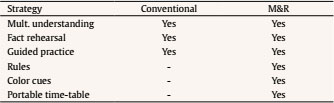
The M&R method was compared to a conventional one, that is, a method that, once the concept of multiplication had been explained, was based on the memory-based learning of the whole multiplication table. With this aim in mind, it uses fact rehearsal and guided practice as the chief strategies (run across Table 1 for a comparison of the strategies used in each method; see also a more detailed description of both conventional and M&R methods, in the Method section).
Tabular array i
Instructional Strategies Involved in the Conventional and the K&R Methods (inside each method the emphasis on one of the strategies may vary)
Multiplication Learning and Individual Differences
An boosted aspect of the present written report has to do with private differences in multiplication fact learning. Educational systems inevitably have to deal with the effect of diversity in the student population; teaching methods that are valid for some students are not always useful for others (Riding, 2007). And so, it is necessary to identify those private characteristics of children that are probable to increase the probability of a successful application of a method (due east.g., Connor et al., 2018).
From a cognitive perspective, differences in arithmetic learning have been related to differences in the mechanisms of working memory, either globally (eastward.chiliad., Bull et al., 2008; Davis & Kelly, 2003; Geary, 2006) or in any of its slave systems, such equally the phonological loop (meet e.g., Lee & Kang, 2002; Schleepen et al., 2016; Swanson & Sachse-Lee, 2001) or the visual sketch pad (run into e.m., Bull et al., 2008; McLean & Hitch, 1999; Passolunghi et al., 2007). Developmental studies have besides shown the role of executive functions in predicting math learning at school (e.one thousand., Bull & Scerif, 2001; Bull et al., 2008). As noted to a higher place, command of interference seems to play a very significant role in explaining individual differences in memorizing multiplications tables (e.thousand., De Visscher & Noël, 2014). Importantly, together with cognitive factors (e.g., phonological retentivity), basic numerical skills similar the comparison of dots and Arabic numbers have also been connected to multiplication fluency (Schleepen et al., 2016; meet De Smedt, 2016 for review), pointing out the relevance of too considering the previous mathematical knowledge of children when facing the learning of multiplication time-tables (see more on this below).
Experiential factors accept also been related to differences in mathematical attainment. For case, children with low socio-economic status (SES) suffer from reduced exposure to situations involving numeracy, and this may affect the normal evolution of their mathematical skills, including multiplication (Perry & McConney, 2010). Motivation may as well play a role in this relationship; Hoffman (2015) has suggested that children's motivation acts as a modulator in the multiplication learning process.
Finally, and near chiefly for the current study, the literature on interventions aimed at increasing fluency in arithmetic has as well identified the importance of individual differences in levels of mathematical skill relating to how students take advantage of unlike interventions. Children with poor accuracy in multiplication tasks respond better to interventions that focus on modelling, and those who prove acceptable accuracy but poor fluency respond better to interventions that focus on repeated practice (Nelson et al., 2013). Some other characteristic which, despite its relevance here, is usually not addressed in research is students' overall level in mathematics. It seems reasonable to assume that a more comprehensive groundwork in math might lead to a more focused approach to multiplication whereas a reduced mastery of math might require a more diverse approach. Within the scant experimental evidence here, Woodward (2006) has shown that children with potent mathematical skills benefitted more than from conceptual instruction than those with poor skills. Clearly, additional research in this area is needed (Nelson et al., 2013). It is beyond the telescopic of the present research to cover all the factors related to individual differences in multiplication learning. However, due to its relevance, an boosted aim of the current study is to analyze the impact that participants' mathematical skills have in explaining the impact of different learning methods. Exploring the relevance of children's individual differences in mathematical skills tin pre-emptively straight practice by targeting those children who respond improve to one method or another (e.g., Connor et al., 2018).
The Current Study
In this study we address ii research questions related to the effectiveness of curricular methods aimed at attaining certain levels of fluency in solving single-digit multiplications: a) does a method aimed to reduce interference, the Grand&R, which combines memory retrieval and single-step rules, lead to greater achievement than a conventional method based on retentivity retrieval of the whole time-tabular array? b) to what extent is the effectiveness of these methods moderated by children's levels of mathematical skills?
To answer these questions, we compared the effectiveness of the Thousand&R method, which seeks to reduce interference through combining retentivity and rules, with a conventional method, but paying attending to the modulator result of children's mathematical skills. Notably, our study compared curricular methods, i.e., comprehensive methods aimed at teaching multiplication and attaining fluency with time-tables in the classroom and did not involve the comparison of small intervention methods simply aimed at achieving fluency in a small subset of multiplication facts or in a special population.
We employed moderation assay (based on linear regression analysis; see Hayes, 2013, for example) to test our hypotheses. Moderation analysis provides bear witness not only of the relationship between ii variables, in this case between a predictor, the type of method, and an upshot (multiplication fluency), but also under which circumstances it occurs, here the values of mathematical skills. In this sense, moderation is similar to the concept of interaction (Fairchild & McQuillin, 2010; Hayes, 2013). Moderation analysis as well has the advantage of using continuous variables (in this case, mathematical skills) and thus avoids the lack of ability associated with artificially categorizing participants in groups (Cohen, 1983), as would have been the case were we to take used an ANOVA.
As we will annotation in the description of the M&R method (see below), at that place is theoretical and experimental support for: i) limiting the number of problems to memorize every bit a means of reducing interference; ii) the effectiveness of unmarried-step rules in providing fast and accurate solutions to arithmetical problems; 3) the relevance of conceptual understanding in learning math; and iv) the benefits of using complimentary material, such as flash cards (equivalent to the portable time-tabular array) and using colour cues, in multiplication learning. So, it is hypothesized that students following this method should outperform those on the conventional method. Less certain is the question of the function of mathematical skills in terms of benefiting from the conventional and the M&R methods. Previous studies have suggested that children with poor skills benefit from strategies based on retentiveness retrieval, such as conventional ones, which include practicing and modelling at the same fourth dimension (Codding et al., 2011; Geary, 2004; Nelson et al., 2013) only there is also testify that methods based on conceptual strategies increase fluency to the aforementioned extent (due east.g., Grey et al., 2000; Mulligan & Mitchelmore, 2009; Woodward, 2006) and may fifty-fifty provide better outcomes than methods based on drill learning (e.chiliad., Brendefur et al., 2015). Taking into account the principles on which the Thou&R method is based, we hypothesized that it will be more effective than the conventional one, and that this volition be more than evident in those children with depression mathematical skills, considering, together with practice and understanding, it provides easy single-pace rules that should facilitate learning by reducing interference. Additionally, the benefits of the M&R method (which involves more guidance), as compared to the conventional one, may exist smaller on children with high mathematical skills, in line with the expertise reversal effect (east.g., Chen et al., 2016; Kalyuga et al., 2003; Nihalani et al., 2011).
Method
Participants
The respondents were 160 children (89 girls) aged 7-8 years, all of whom were second form students in a charter school in Malaga (Espana). Children were from diverse socio-economic backgrounds, but most were from a medium socioeconomic level. An additional group of eighteen students diagnosed with developmental disabilities (i.e., dyscalculia, dyslexia, attentional bug) took part in the report, but were excluded from the analyses. Participants were fatigued from 8 different classrooms. In four of these (lxxx children, 41 girls) the conventional process was followed during the 2014 academic year, and in the other four classrooms (80 children, 49 girls) the Grand&R method was followed in 2015. However, in both cases the methods were applied while children were in 2d grade. Informed consent for children was obtained thorough the schoolhouse's staff.
Materials and Procedure
The two multiplication methods were followed for 6 months (January to June) as role of children's second course math classes. Both groups were evaluated at the end of the schoolhouse year, after having finished the method.1
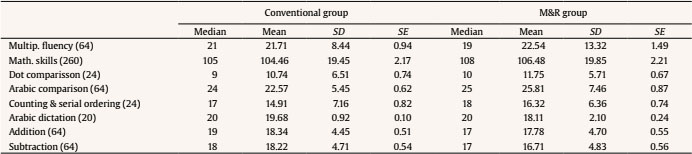
A mathematical skills test (BERDE: Batería para la Evaluación Rápida de la Discalculia Evolutiva [Bombardment for Rapid Evaluation of Developmental Dyscalculia]; García-Orza et al., 2014; meet www.ladiscalculia.es) was used to determine the mathematical skills of each student. BERDE is designed to explore basic numerical skills in students from grades one to vi. Information technology provides an assessment of different mathematical skills, including dot and Standard arabic comparison tasks, number line tasks, counting and series ordering, Arabic number writing to dictation, single-digit addition, subtraction and unmarried-digit multiplication. In the dot comparison, Arabic comparison, and addition and subtraction tasks, participants were asked to solve as many problems as possible in a fixed period of time (1 minute for the comparing tasks, 2 minutes for the arithmetic tasks). In the transcoding task and the counting and serial ordering tasks, participants had no time limit to solve the subtests. A factorial analysis of the information on the test revealed a structure with ii factors, one related to the comparison of quantities, other related to numerical-exact skills. This resembles the original structure of the test, validated with children from commencement to sixth grade. Internal consistency of the factors, as measured by Cronbach'south alfa, was .71 for the first gene and .threescore for the 2nd. For this study, a global math score (excluding the score in the multiplication task) was obtained for each participant. This score consisted of the sum of the scores obtained for all the tasks (excluding multiplications). Comparisons of the math skills betwixt groups did non evidence significant differences (encounter Tabular array 2).
Table 2
Descriptive Statistics for Multiplication Fluency Task and Mathematical Skills Examination in Each Method Group (scores in each subtest of the mathematical skill assessment tool are also included)
To assess multiplication fluency, the multiplication fluency test of the BERDE was used in a different session. Children were provided with a booklet including 2 sheets with single-digit multiplications in two columns, with xv problems in each cavalcade, for a full of sixty problems. Ties issues (e.g., three x three), smaller-operand starting time (e.yard., 3 ten seven), and larger-operand start bug (due east.grand., 7 x 3) were included in the prepare. Problems were semi-randomly ordered with the aim of avoiding the consecutive appearance of the same trouble with a different order. It was explained to the children that they had ii minutes to solve equally many problems equally they could. Instructions stressed that problems should be performed in columns and that no bug could be skipped. The score was calculated as the number of bug correctly solved minus those solved incorrectly.
The Curricular Methods
Kickoff, we notation that both methods described here emphasize the practise of fact retrieval as a key agile component, and both use the same textbook (Labarta et al., 2011), Matemáticas ii Primaria. Conecta con Pupi [Mathematics 2nd grade. Connect with Pupi], SM Editorial. However, whereas in the Grand&R method this was used as complementary material (information technology was mainly used as an activities database), in the conventional method it was the principal guide for learning. This deviation involved that rules, including the commutative principle, and time-tables, were presented in a different temporal sequence and with different purposes in each method (see below for more details on this). In both cases the children practiced retrieval with the exercises in the textbook and with additional work-sheets, and these materials were ever adjusted to the lesson in question. The textbook includes sections which explain the concept of multiplication as repeated addition, then the tables, and finally the commutative rule is briefly explained. The primary differences betwixt methods are described in the following sections.
The Conventional Method
The basis of this method is memorizing the tables from 1 x ane to 10 ten 10 through the utilise of rote exact learning and repeated practice with problems. Although during the learning process some conceptual knowledge is presented, and information technology is usually pointed out that some tables can be learned by rules, the time-tables with all the problems are ultimately learned by memorization.
Three phases were included in this method. During the first phase the concept of multiplication was explained to children using exact and visual examples. They were also asked to convert repeated additions into multiplications (e.g., 3 + iii + 3 + 3 + 3 = 5 10 3). In the second stage the rote verbal learning of tables from 1 ten 1 to 10 x x was stressed by reciting the sequences in the classroom and past practicing problems. Following the textbook, the ii and iv time-tables were learned get-go, so i and ten, followed by 5, and finally 3, six, vii, 8, 9, and 0. For the learning of each time-table, the procedure in the classroom was as follows: initially the table was presented and was recited by all children several times. They were so provided with time to recite the table themselves, to practice problems, and to report it at home. During the following schooldays they were asked the tabular array in full and also in private bug presented verbally or in a booklet. After a variable filibuster, according to what the teacher considered advisable, the learning of a new table was presented. Finally, in the tertiary stage, once all the tables had been studied, the children were presented periodically with unmarried-digit problems to be solved as part of math class activities, and then the commutative rule is explained.
With some pocket-sized variations, this is the method followed by the majority of schools in Espana (Aguilera et al., 2019; Fernández, 2007; Labarta et al., 2011) and in other Spanish speaking countries (Blanco-Solórzano, 2020). It is based on establishing and reinforcing the clan between all the problems and their solutions in students' long-term retentiveness without relying likewise heavily on the concept of multiplication and its backdrop.
The Retentivity and Rules (G&R) Method
This method combines the utilize of retention learning and unmarried-step rules with the aim of learning to solve single-digit multiplications. It shares with the conventional method the fact that learning by retention provides an efficient way of attaining fluency but emphasizes conceptual understanding and promotes the apply of single-step rules in society to reduce the number of problems to memorize, and then the interference associated with this process. Additionally, the method complements the memory learning process past cueing multiplication tables with color in a portable time-table. In this manner information technology seeks to reinforce the association betwixt bug and their solutions (the materials of the method, in Spanish, can exist downloaded from www.ladiscalculia.es).
The method is based on educational strategies practical in certain countries (e.thousand., China) and in response to suggestions in previous research (east.g., Isaacs & Carroll, 1999; Miller et al., 1996); more chiefly, information technology is likewise based on evidence from cognitive and educational psychology studies. Equally noted above, multiplication coding and retrieval is hindered by similarities in the material to be stored and retrieved (eastward.g., Campbell, 1987, 1995; De Visscher & Noël, 2013, 2014a, 2014b, 2015; Dowker, 2005; Verguts & Fias, 2005). A simple way of "reducing interference" is by reducing the number of problems to exist memorized, and this tin can be done easily using rules.
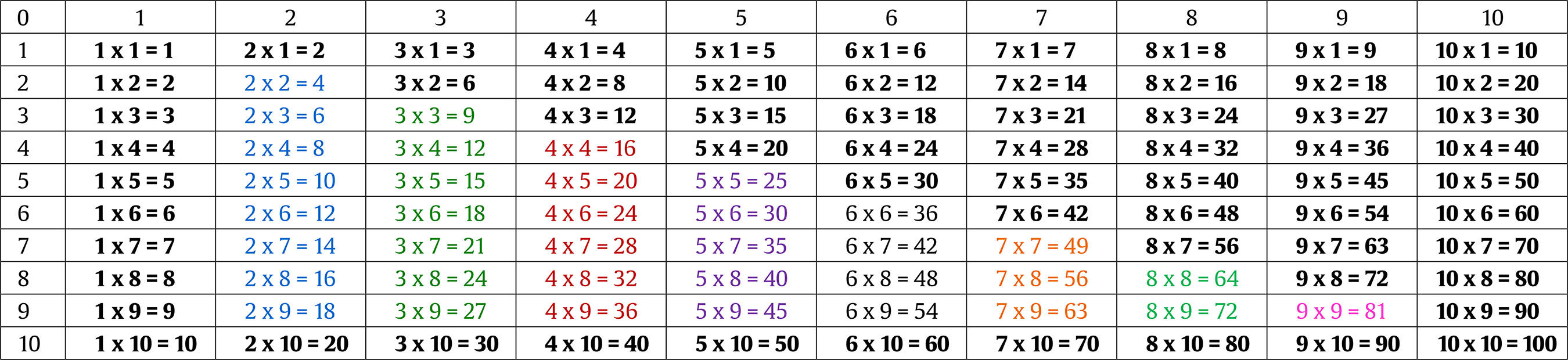
In the Thousand&R method, rules were used to learn the 0, 1, and 10 tables, since their solutions involve a single-step procedure: a x 0 is e'er 0, a x i is a, and a x ten is a0 ( 'a' beingness any natural number). Additionally, this method used another unmarried-step rule, the commutativity principle: a 10 b = b x a (a and b being whatsoever natural numbers, and a ≤ b), so that but bug in one direction (larger x smaller or smaller ten larger) needed to be learned, in this instance a 10 b issues. Instruction was also provided for children, so when faced with bug of the blazon b x a, they were asked to apply a change of social club. By using these unmarried-step rules the method reduces the number of problems to be memorized from the original 100 bug (from 1 x i to 10 x ten), to 36 (come across Figure one). Together with detailed explanations of the rules, children were also asked to practice trouble solving using these rules, since testify suggests that practicing rules make them more efficient (e.g., Ericsson et al., 1993). For example, research in this area has shown a rapid transfer of the knowledge of the solution to a 10 b problems to b x a problems (eastward.m., Baroody, 1999).
Figure 1
A Portable Time-table Showing the Issues to Be Learnt past Memory with a Color Code, and Those to Be Learnt by Using Rules (shaded).
After the application of single-steps rules, children needed to learn a small subset of problems by retentiveness. To assist in this procedure nosotros employed ii strategies:
a) A portable time-table was provided for the children (see Figure i). Printed on half of a DIN A4 plasticized sheet, it included the multiplication tables on i side, each ane in a different color, with an indication of those problems to be learned by rote verbal retentivity, and those (shaded) which were non to be thus learned. On the other side information technology included the single-step rules described above, every bit rationale for not learning the shaded problems. Students were asked to take this sheet with them at the cease of each day. Simultaneously, affiche versions (A1) of this sheet were hung in the classroom. The portable time-tabular array was designed to serve two purposes: to increment the opportunity of repeating the tables at whatsoever moment and to increase children's motivation past pointing out the relevance of learning the tables using extra-curricular material. As summarized in the Introduction, motivational likewise equally experiential factors play a role in mathematical learning, and although this method does non focus specifically on these topics, the employ of the portable fourth dimension-table tries to address these issues.
b) Problems in the portable time-tabular array were cued with colors. The aim of this was to provide implicit data that is stored in memory and can help children to organize a network of bug. According to some models, during the learning process a network of operator and result nodes is built (eastward.grand., Ashcraft, 1992). In this network, problems that share operands (e.g., 4 10 5 = 20; 4 10 8 = 32) are associated, and this information is also coded in their respective solutions. Previous research has shown the benefits of cueing the learning of multiplication tables with color (eastward.chiliad., Domahs et al., 2004; Kaufmann & Pixner, 2012).
The application of the Yard&R method had the post-obit phases: first, children were presented with the concept of multiplication and its understanding was encouraged. As office of this agreement, multiplications by 0 and by one were presented. Subsequently, the commutative property was introduced. The last rule presented was the multiplication past 10 rule. Each of these steps was accompanied by the presentation of the time-table and the consequence for memory learning of using this rule. For case, after understanding the dominion for multiplication by ane, these problems were shaded in the portable time-tabular array. Subsequently learning the rules of the multiplication tables, the table with shaded problems was presented and children were encouraged to learn past memory those 36 problems that were not shaded, starting with the two fourth dimension-table and moving successively to the nine fourth dimension-table. Emphasis was placed on starting each table with the ties (e.g., ii x 2; 3 x three, etc.) and using the commutative principle to retrieve the smaller 10 larger problems (east.g., 2 ten 3).
To sum up, the Thou&R method, as with the conventional method, emphasizes memory in learning the clan between problems and solutions. However, it does and then on a reduced subset of problems and uses color as an boosted cue for recall, whereas for the balance of the issues the method relies on single-step rules. An boosted deviation between the methods is related to the accessibility of the tables. The portable fourth dimension-table makes it easier to consult the solution when doubts ascend and as well makes studying it easier. Moreover, its use as a novel resource probably has the effect of showing children the relevance of learning the tables, and the potential motivational office of the portable time-table equally a didactic tool cannot be dismissed.
Design and Analyses
Descriptive statistics were conducted separately for the conventional grouping and the M&R grouping. The exploratory analysis indicated that distributions departed from normality, and that homoscedasticity was not attained, and so non-parametric statistics were preferred for data analyses.
Non-parametric correlations between mathematical skills and multiplication fluency were developed separately for each group; nosotros besides compared the mathematical skills and the multiplication fluency between groups.
A moderation analysis was run to evaluate our hypotheses. This analysis is an alternative to ANOVA for exploring the interaction between the method factor and the level of mathematical skills in predicting multiplication fluency. The moderation assay was conducted with the Process module by Hayes (2013) for SPSS version 23. This macro uses a non-parametric resampling test that does not rely on the normality assumption and tin be used with minor samples. Additionally, it includes a procedure to analyze information even when the homoscedasticity of the errors in the estimation of the dependent variable is not assumed (Hayes, 2013). We employed a two-independent group pattern. The type of curricular method was the independent variable (X), and the scores in the multiplication fluency chore were used as a dependent variable (Y). Children's level of mathematical skills was the moderator variable (M). A detailed illustration of the testing of moderation effects is available in Hayes (2013) meet as well (Figure 2a). In assessing moderation, the effects of main interest are b1, b2, and b3, these corresponding to the furnishings of each factor, and to their interaction, this is, if X's effect on Y varies with M, respectively (encounter Figure 2b). The moderator, type of method, was mean-centered prior to the analysis. The categorical predictor type of method was coded as -.fifty for the M&R method and +.l for the conventional group.
Effigy 2
Moderator Model Figure.
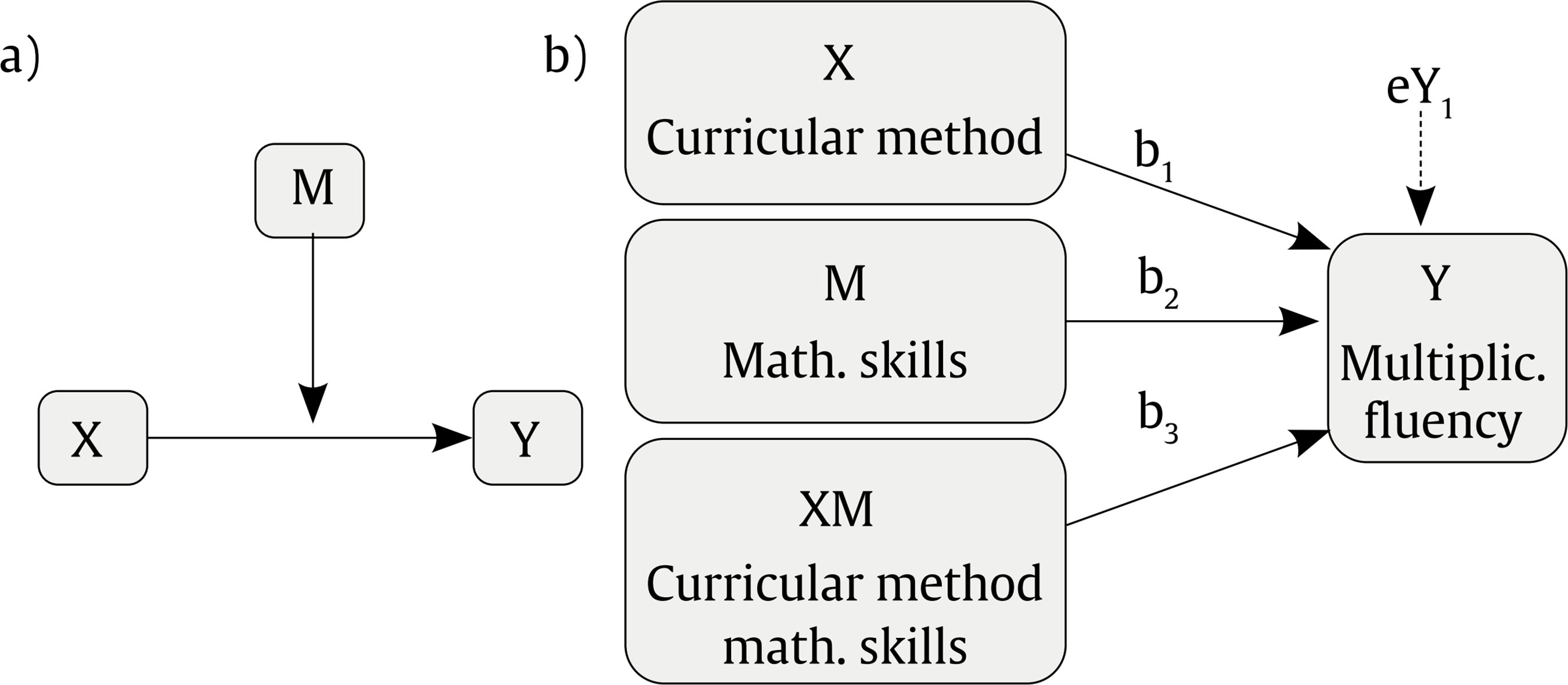
Note. a) Simple moderation model (see Hayes, 2013). b) Depiction of the effects explored in the moderation model in the study. In figure 2b, b1 quantifies the consequence of Ten (Curricular method) on Y (Multiplication fluency), b2 quantifies the effect of M (Mathematical skills) on Y (Multiplication fluency), and b3 quantifies whether the effect of X (Curricular method) on Y is chastened by Grand (Mathematical skills).
Results
Descriptive statistics for the dependent variable and the moderator for each method group are shown in Tabular array 2. A non-parametric test for two independent samples indicated that the mathematical skills of children in the M&R group were similar to those in the conventional grouping, Z = 0.55, p = .58 two-tailed. Similarly, no differences were observed in multiplication fluency when both groups were compared, Z = 0.99, p = .32 two-tailed.
Overall, the correlation between multiplication fluency and the moderator, mathematical skills, was meaning rho = .42 (p < .001). This correlation remained meaning when information technology was analyzed separately in the M&R grouping, rho = .56 (p < .001), and in the conventional grouping, rho = .29 (p = .009) (see Figure three).
Figure 3
Scatterplot Showing the Human relationship between Multiplication Fluency and Mathematical Skills in the One thousand&R and the Conventional Method Groups.
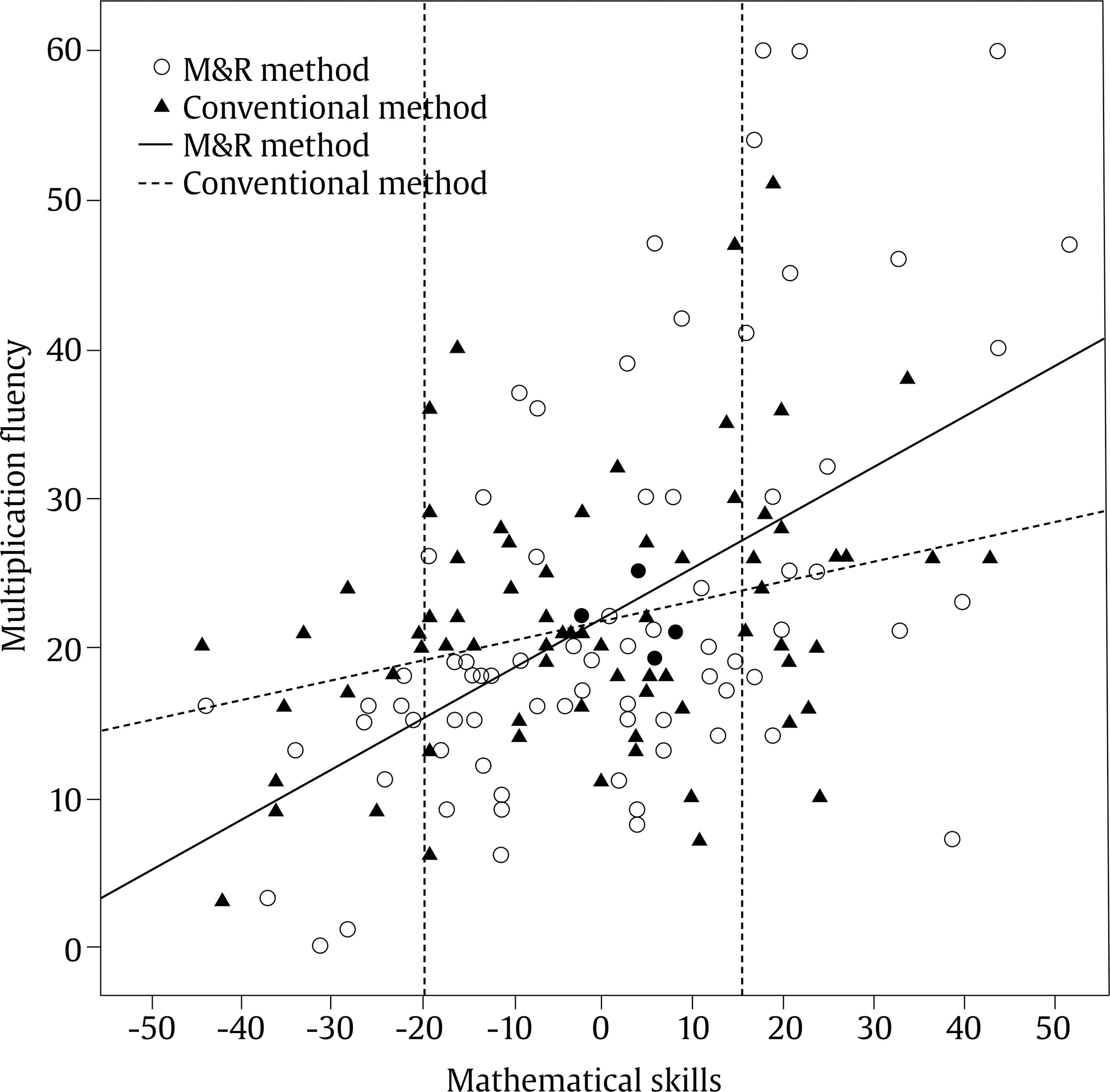
Annotation. Regresion lines for each method as estimated by the moderation model are included. The area between vertical dashed lines (-xix.60 to +xvi.47) indicates those values of mathematical skills at which differences in multiplication fluency between groups are not significant according to the Johnson-Neyman technique. In the 10 axis, as mathematical skills were centered, a value = 0 indicates the hateful.
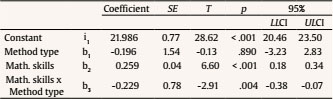
Table 3 includes the results from the moderation assay. The model including the type of method, mathematical skills, and the interaction of both variables, significantly predicted the results in multiplication fluency: F(3, 156) = 17.74, MSE = 94.05, p < .001, R ii = .25. No effects of type of curricular method on multiplication fluency (b1 = -0.196, p = .89) was found, this reflecting at that place is not a lineal relationship between method and multiplication fluency at values of mathematical skills equals to 0. The event of the moderator, mathematical skills level, was meaning (b2 = 0.259, p < .001), indicating that multiplication fluency increases with mathematical skills. More importantly, the interaction term indicated that the relation betwixt the method type and multiplication fluency was moderated past children's mathematical skills (b3 = -0.229, p = .004).
Tabular array iii
Model Summary of the Analysis Examining whether the Issue of Method (X) on Multiplication Skills (Y) is Moderated past the Level of Mathematical Skills (M)
Using a Pick-a-Point approach, the interaction was analyzed by testing the effects of type of method at 3 levels of mathematical skills: one standard deviation below the mean, at the hateful and one standard deviation above the mean (eastward.chiliad., Hayes, 2013). The assay (run into Table 4) shows that the effect of type of method on multiplication fluency was statistically significant at i standard difference below the mean, thus indicating that at this level of mathematical skills children in the conventional grouping scored higher in multiplication fluency than those in the M&R group. On the other mitt, for values at one standard deviation to a higher place the hateful, those in the Thou&R method outperformed those in the conventional method. Finally, no differences were observed in multiplication fluency betwixt groups at the hateful of mathematical skills.
Table 4
Provisional Effect of type of Method on Multiplication Fluency at Values of Mathematical Skills (betwixt brackets the values of the moderator, maths skills centered, at each point)

A deeper analysis of this interaction with the Johnson-Neyman technique, that is, without categorizing a priori children in terms of mathematical skill levels, showed a difference between methods in favor of the conventional group for those participants with values of mathematical skills lower than -xix.60 (15.vi% of the sample). On the other hand, for participants with values of mathematical skills higher than +16.47 (22.5% of the sample), those in the M&R method showed higher multiplication fluency than those in the conventional method. No differences were found between methods for children with values of mathematical skills in the range -xix.60 to 16.47 (run across Effigy three).
Give-and-take
The present study has sought to compare the effectiveness of two curricular methods for learning multiplications. The Thousand&R method, based on evidence and principles of cognitive and educational psychology, combines the use of memory and rules, the other, a conventional method, uses memory-based learning. An additional question was the part of individual differences in mathematical skills in terms of benefitting from these methods. Each method was followed in iv classrooms over a six-calendar month flow equally part of the math curriculum of second grade students. At the end of the schoolhouse year, children were evaluated. Results indicate that the relationship between method and multiplication fluency was moderated by mathematical skills: a) among children with strong mathematical skills, those post-obit the One thousand&R method had achieved greater multiplication fluency; b) no difference was seen in children with intermediate levels of mathematical skills; and c) amongst children with poor mathematical skills, those following the conventional method scored better. In what follows we will discuss these results.
Kickoff, the analysis indicates simple effects of mathematical skills on multiplication fluency and no effects of method, although these results were qualified by an interaction between both variables, i.e., moderation. This moderation assay showed the relevance of private differences in terms of the advantages of one instructional method or the other, the relative benefits of the ii methods existence modulated by children'southward mathematical skills. Against our predictions, children with poor mathematical skills attained greater fluency with the conventional method, whereas children with stiff mathematical skills progressed more with the G&R method. In understanding these results, it may be useful to bear in mind that the Thousand&R makes more demands on numerical and arithmetical understanding than the conventional method, which relies more than on the memorization of the tables. It is maybe not surprising, then, that students with strong mathematical skills benefitted more from a method based on conceptual understanding of rules and on retentivity than from one based almost exclusively on retentivity. Their cognition of mathematics facilitated not but the understanding of the concepts and the single-footstep rules on which the method is based, but also of how to utilize these rules. Additionally, the time saved in learning problems through the use of rules can be employed in learning by memorization the smaller subset of multiplication facts that cannot exist learned by rules. Our results here coincide with other research in the area of multiplication fluency intervention, which has found greater benefits for interventions based on understanding than for those merely based on memory. For instance, Brendefur et al. (2015) employed a form of instruction based on social-interactional and cognitive theories for five weeks, comparing this to one based on behavioristic techniques such equally repetition and memorization. They plant that the former led to increased multiplication fluency with a greater caste of consistency than the latter. Our data are in line with this, but also betoken that such a relationship is chastened past mathematical skills, equally we plant this only in the example of children with stiff mathematical skills. Unexpectedly, we observed the opposite pattern in children with poor mathematical skills, in that those who followed the conventional method outperformed those that followed the M&R method. This is probably motivated past the higher demand on mathematical skills that the M&R method makes on children with poor mathematical skills. This method is based on achieving a proper understanding and constructive use of the rules. Testify suggests that for teaching to be productive it should include materials at an appropriate level of skill difficulty (Burns et al., 2006), and it seems that the Grand&R method did non do this for children with poor mathematical skills. On the reverse, children with poor mathematical skills who followed the conventional method gained greater fluency, this probably considering they had a clearer agreement of what they were required to practise (and how): memorize the multiplication tables. For children with poor mathematical skills, our results are in line with previous research and a meta-analysis that found that the multiplication fluency of children in the lower quartile for mathematics, or who experienced other learning difficulties, benefitted more than from intervention methods based on drill and practice with modelling (Codding et al., 2011; Geary, 2004; Nelson et al., 2013), these being ii components that form the basis of the conventional method.
Ane of the aims of the present study was to compare the relative effectiveness of the conventional and the M&R methods. There is no unmarried finding hither since, as we take noted, benefits depend on children'due south mathematical skills. The M&R method was designed in light of earlier studies (e.thousand., Isaacs & Carroll, 1999; Miller et al., 1996; Woodward, 2006), and past taking into account evidence in the cognitive psychology literature on the detrimental role of interference (e.g., Campbell, 1995; De Visscher & Nöel, 2013, 2014a, 2014b, 2015; Geary, 2006; Kaufmann, et al., 2004) and the beneficial role, in terms of accuracy and speed, of single-step rules in mathematical achievement (Baroody, 1983, 1999; Ericsson et al., 1993; Uittenhove et al., 2016). Additionally, to reinforce the retention learning of a subset of multiplication problems, colour cues and a portable time-tables were used. This should have been enough to promote meliorate levels of multiplication fluency than the conventional group. And indeed, this was the example for the 22.five% of children with better mathematical skills. An additional positive characteristic of the One thousand&R method is that efforts are constantly made to ensure the agreement of the rules. This is based on the idea that but learning an algorithm (due east.g., if a larger x smaller problem is given, just reverse it) is non every bit useful equally agreement its conceptual ground. As previously noted, studies in the mathematical field accept shown that conceptual education provides both understanding and better transfer to novel situations (due east.g., come across Rittle-Johnson & Alibali, 1999; Rittle-Johnson et al., 2001) and promotes students' success and independence (Miller et al., 1996). Specifically, some data suggest that gains in fluency using memory procedures are not always accompanied by a flexible apply of multiplications in other areas, such equally problem solving (Brendefur et al., 2015; Geary et al., 2007; Woodward, 2006). On the contrary, it seems that intervention methods that use more conceptual approaches to learning facts, equally the Thousand&R does, increase non only fluency but also children'southward ability to apply these skills to novel situations (e.g., Grayness et al., 2000; Mulligan & Mitchelmore, 2009; Woodward, 2006). Thus, it seems reasonable to believe that the M&R method is better adapted to achieve this than the conventional approach, although nosotros should make this claim with caution, given that our written report did not measure children'southward flexibility in the use of multiplication in different settings.
A directly implication of our results is that more time should be provided for understanding the rules when using the Thou&R method with children who take medium and poor mathematical skills. The worst observed effectiveness of this method with children with poor mathematical skills does non seem to be a consequence of wrong blueprint, just of incorrect implementation. A minimum level of mathematical skills is required in order to empathise the rules, and indeed is a pre-requisite for running the method. The lack of specific mathematical skills may lead to a failure in agreement and in assuming the relevance of the rules and the logic behind the use of each strategy. So, when working with children with poor mathematical skills, the focus should be on increasing their mathematical cognition prior to implementing methods that are based more on understanding than simply on memorization.
An important implication of our findings is the demand to individualize teaching for students who present different mathematical skill levels, equally suggested in previous studies (east.yard., Connor et al., 2018; Morgan et al., 2015). Although this itself leads to certain complications, information technology seems that from the basis of a well-designed method, depending on the characteristics of the children, the method tin exist complemented in such a style that those with poor and medium mathematical skills are able to derive the same advantages that the M&R method provides for children with strong skills. Future implementation of this method with complementary fabric to promote agreement of the rules should yield evidence on its suitability to such children.
Certain limitations of this study might usefully be pointed out. First, as noted above, participants' mathematical skill level used in the analysis was taken at the aforementioned time every bit the multiplication fluency task. Although it is expected that the measure of mathematical skills at the end of the application of the method would prove a loftier correlation with the level of mathematical skill earlier starting the multiplication methods, a previous mensurate would permit us to establish a more than causal human relationship between mathematical skills and the effectiveness of the methods. In fact, the measure out of mathematical skills in the Chiliad&R group taken one year before, that is, at the end of their first grade, showed a high correlation with the mathematical skills taken at the end of the application of the M&R method, rho =.516 (p < .001), thus the latter can be considered an acceptable proxy of the former. Similarly, the written report may have benefitted from a broader measure of multiplication cognition, not limited to fluency, and from testing the maintenance of the furnishings of the methods. This may have provided a improve understanding of the differential benefits of the methods.
Additionally, it should be noted that since the M&R method is based on different psychological principles, our report cannot disentangle the relative part of each of these in the success of the intervention. As indicated in the Introduction, at that place are expert reasons to expect that both reducing the number of facts to memorize and using color cues to code the problems can help students in encoding and retrieving the problems more than effectively in their long-term-retentiveness (e.g., Kaufmann & Pixner, 2012). Moreover, informal comments by both children and teachers suggests that using the portable multiplication table may take helped some students to encounter the learning of multiplications as a more attractive activity.
Finally, although the groups involved in the methods all belonged to the same school, information technology may be that the presence of different teachers and the not-random assignment of the students to the methods might take introduced some differences, and thus that students on the dissimilar methods may have differed in terms of mathematical knowledge, multiplication skills, or even in cognitive processes relevant for this learning (due east.m., executive functions, working retentivity, phonology). Although this cannot exist discounted, it should be borne in mind that no between-group differences were constitute in the measures of mathematical skills (see tabular array ane). Additionally, an analysis of intraclass correlation (ICC) indicated that there were not high levels of correlation inside each group, ICC= .37, Z-Wald = 1.45, p = .15, suggesting participants in both groups have similar characteristics. It is likewise a concern that our report has been carried out in a charter schoolhouse, not a public school, and this could diminish the generalizability of our enquiry. Although public schools are by far more frequent in Spain, 68%, charter schools are very mutual in Espana (28%), and more importantly, do not differ greatly in the type of children they receive and the educational practices they employ (Eurostat, 2020). In support of this, according to the last PISA report, once the students' socioeconomic level is considered, the differences in student's performance between public, and charter and private schools disappear (OECD, 2019). And so, with all due caution in this regard, information technology seems that, at least in Kingdom of spain, our data may be generalized to students in other schools.
Several other issues in our study might as well be highlighted with regard to previous work in the area. Beginning, we implemented and compared teaching inside curricular methods, not interventions. So, the methods were implemented equally part of math lessons given by the children'due south math teachers during the schoolhouse term. In this sense our study is more ecological and might serve to guide teachers' daily school activity (Star & Rittle-Johnson, 2016). It does not innovate foreign variables in the daily class action in the fashion that most intervention studies do. However, the price to pay for being more than ecological is having less experimental control, in that nether these circumstances the random consignment of children to groups is not possible (see above). 2d, an boosted force of the present report is that it analyzes the bear on of these methods through looking at diversity, specifically by because the fact that children differ in their overall mathematical skills. Third, by using a linear regression model, in this case moderation analysis, our study does not categorize children in terms of mathematical skills groups ad hoc, but past means of statistical criteria. This allowed for a more precise analysis of the data.
Conclusion
The present study has shown the differential benefits of ii different methods of learning multiplication. A conventional memory-based method seems to be more efficient for children with poor mathematic skills, whereas a method based on understanding and using rules, and which limits the number of facts to exist learned, seems more effective for children with stronger mathematical skills. Although these results should be taken with caution given the limitations of the current written report, information technology seems that taking private differences in mathematical skills into account appears to be a fundamental prerequisite of instructional methods equally practical in the classroom for the learning of multiplication.
Source: https://journals.copmadrid.org/psed/art/psed2021a14
0 Response to "Preferencias Textbook Indicate what these people want to do, using the cues provided."
Postar um comentário