Again Fish That Can Handle 80 Temperatures
You might not be able to come across it, simply your fish can certainly feel it.
I'grand talking almost water temperature, and as you will soon learn, it's pretty a pretty big bargain.
In fact, if you don't monitor the aquarium temperature, then you are putting the lives of your fish at risk!
Come across, I told you it was important.
Merely don't panic just yet.
Today, I am going to teach you everything you need to know about water temperature, including why it'due south then important and how you tin maintain the perfect aquarium temperature.
Temperature in the wild vs in your tank
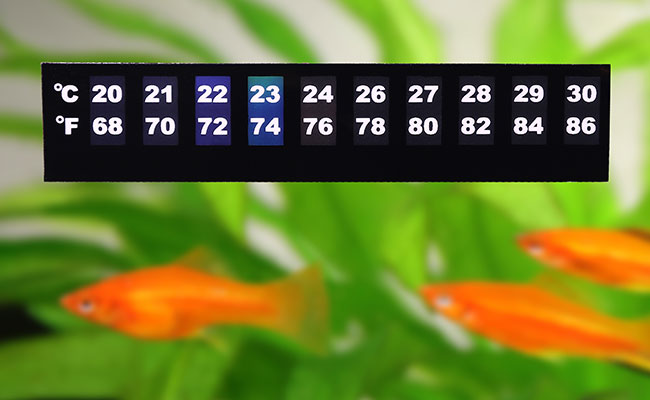
All fish have an ideal temperature range where they will thrive. Yes, I said range – in near cases, your fish practice not need an exact aquarium temperature.
This makes sense, I mean, in the wild, there is no aquarium heater ensuring that the water temperature remains abiding. Pelting, hot summertime days and cold winter nights all work together to ensure that fish in their natural surround do not feel the same temperature for too long.
In fact, freshwater fish can experience daily temperature swings of 30°F or more. Fifty-fifty in the reef environs, the daily temperature swings from 68-xc°F (twenty-32°C).
So if this is the instance, then why practice we insist on keeping our aquariums at a abiding and stable temperature?
Well, it all comes down to how fast the aquarium temperature swings.
Because oceans and rivers incorporate so much water, it takes a long fourth dimension for the temperature to rise or drib. The change in temperature can have a day or even a flavour to complete.
Your aquarium, on the other paw, is not so lucky. The pocket-size amount of water tin can rapidly heat up or absurd downwards based on the temperature outside the tank. It is this rapid change in temperature that is the problem.
So in your domicile aquarium, the goal is to maintain a water temperature that is inside the preferred range of your fish, invertebrates, plants or corals.
Temperature and fish health
What practise you do if you feel cold?
You lot probably put on a sweater or plow upward the thermostat. I know I would.
On the flip side, what would yous practice if y'all feel besides warm?
Plow on the air conditioning or grab a refreshing drink, right?
Unfortunately, these are not options for your lilliputian fish.
You see, your fish are common cold-blooded. And, it might surprise you to learn that this does not mean that their blood is common cold.
Instead, information technology means that your fish cannot regulate their internal body temperature – every bit the water temperature changes, then does their body temperature.
Water that is too warm or too cool becomes uncomfortable.
In the wild, a cold fish would simply swim to warmer h2o. Similarly, a warm fish would chase out a nice cold spot.
But the fish in your aquarium? They don't have this luxury and are forced to suffer the aquarium temperature… There is no escape, fifty-fifty if they wanted to!
Unfortunately, this temperature can accept a negative impact on the health of your fish. In particular, the water temperature has a direct effect on your fish's metabolism.
If your tank temperature is too cold, so your fish'southward metabolism volition slow down, which leads to your fish becoming sluggish and sleepy.
On the flipside, water that is also warm causes your fish'southward metabolism to speed up. Your fish will become more than lively or even hyperactive.
While that might not sound too bad, these rapid fluctuations in temperature have been proven to cause stress. And, you don't want that! Stress is arguably the number one reason why aquarium fish die…
You see, the stress caused by fluctuating temperature weakens your fish'south immune system. Even fish that are briefly exposed to temperature swings are less resistant to disease and parasites like Ich – which feed on the fins, skin and gills of your fish.
Usually, your fish's immune system would easily fight these off – they are no friction match for healthy fish. But when temperature-stressed, your fish are an easy target for these diseases and parasites, which can soon kill them.
The life of your fish depends on your ability to maintain the correct temperature.
Don't have fish? You'll still need to keep an eye on the temperature. Invertebrates, corals, plants and algae accept all been observed to be negatively influenced past temperatures outside of their preferred range.
Even the beneficial leaner in your aquarium are affected by water temperature. The preferred range is 65-85°F (18-29°C). At 95°F (35°C), bacteria die, which tin atomic number 82 to ammonia spikes. Lower temperatures cause the bacteria to become less agile and tin can even make your aquarium take longer to cycle.
Equally you run across, it's pretty important that y'all continue your aquarium at the correct temperature…
How to position the heater correctly?
One must ensure that the temperature of your fish tank water is consistent with the fish species you lot intend to go on, as these creatures are naturally accustomed to warm/cold water.
If you are setting up an aquarium, the temperature should be like to your fish's natural environment. You should place the heater backside the aquarium or tank.
Or, at the least, make certain information technology is virtually a chief source of water flow. It should not be in directly contact with other objects that can block its heat, such as rocks, plants, or substrates. Place it so that when y'all look at your fish tank from the front, it is on the right or left side where at that place is a lot of motility in the aquarium water to keep it circulating correctly.
Information technology's likewise essential to place any thermometer y'all're using side by side to your fish tank considering heaters piece of work less efficiently if they're too close or too far away from them.
When setting up your aquarium, you should ensure the heater does not contact the walls or substrate. If your heater has a glass casing for protecting its internals, the significant difference in temperature beyond the layer of material could crack your enclosure and potentially harm your fish.
Providing your tank with consistent, sufficient rut is 1 of the many ways to ensure that all of your fish are comfy and able to thrive.
If you lot have an aquarium heater, then the best identify for it is in a location where the water passing over the device makes constant contact and so that the conduction and convection process can finer transfer warmth evenly throughout your entire tank.
Some other worthwhile location is near an intake or outlet tube because that style, hot spots will not form on or around your heater, which could lead to sudden power-off. It can simply create an uncomfortable living environs as these areas would exist much warmer than they should be.
What happens if your aquarium temperature is too high?
Warm h2o causes the biggest issues, typically once temperatures exceed 90°F (32°C).
Your fish breathe by drawing oxygen out of the water. And under normal conditions, your aquarium volition have more than enough oxygen to go around.
Warm water causes your fish to go more agile and require more oxygen. Just one problem – warm h2o actually holds less oxygen than cooler h2o. In severe cases, at that place won't be plenty oxygen to go around, and your fish tin suffocate.
To add to the disaster, the beneficial bacteria in your aquarium need oxygen to break down ammonia. Without enough oxygen to go around, the ammonia in your tank begins to build upwardly, displacing oxygen and burning the gills of your fish.
Equally yous see, warm h2o can kick-start a number of deadly problems in your aquarium.
What to do if the temperature gets also high?
There are several ways to proceed an aquarium cool. Aquarists will have to figure out what works all-time for them past considering the circumstances at hand and the species of fish they take in their tanks.
What works for ane won't necessarily work for another, so it is essential to consider the situation and make a plan accordingly.
Air-conditioning
Out of all the elements used to go on an aquarium at advisable temperatures effectively, at that place is 1 that you should be sure to have: a cool outside environment.
By maintaining a cool temperature around the aquarium, it volition, in well-nigh cases, ensure that the temperature inside the tank doesn't rise beyond safety range.
Frozen water bottles
Frozen water bottles brand the perfect temporary ice cubes for an aquarium. Information technology is a cheap and easy way. Many people use this method. The frozen water bottle method works differently from regular water ice cubes, which tend to cook fast and cause havoc in your fish tank.
You may take heard of another aquarium cooling arrangement involving modest glass tubes with water inside them packed in a container with the fish tank. It gives off the same effect equally the frozen water bottles but is comparatively more expensive to buy due to its components beingness replaced time after time.
Run a fan direct on the surface
This is a quick and like shooting fish in a barrel solution to the problem of stagnant water at the tank'due south surface. The downside is that more water will need to exist added to supersede what has evaporated since it increases evaporation rates.
Reduce natural and bogus lights
Install blinds in your aquarium room to block out light when temperatures ascension every bit likewise much artificial lighting can seriously damage tank inhabitants, too. As artificial lighting has been known to introduce algae blooms that tin can quickly spread, we propose turning off lights in the aquarium if not needed while working in the room.
Install a skillful filtration system
Use proper water filtration equipment by installing water-filtration systems and new filters each fourth dimension they become chock-full. It will keep water quality healthy and ensure that the fishes inside are flourishing without run a risk of damage coming to them.
What happens if your aquarium temperature is besides low?
For tropical fish, low temperatures can also cause a problem. At lower temperatures, these fish can become boring and sluggish, and many will soon die.
It's similar to how you tin can survive exterior without apparel or bedding. However, the experience would be uncomfortable, and yous would soon take hold of a cold or the flu.
What to do if the temperature gets too depression?
Every bit fish are cold-blooded, they have a high sensitivity to changes in temperature. You must maintain aquarium temperature with dependable equipment for your aquarium heaters.
Invest in expert water heating equipment
A good heater will have a born thermostat that tin automatically turn the heater on if the temperature changes. Some heaters have a unmarried temperature setting, but more than advanced models use a timer or sensor to regulate the tank'southward temperature. Many people position their heater in the center of the tank to help go on tank temperatures stable, and at that place are detail types of heaters that work all-time for specifically sized tanks.
Become a thermometer
You should as well invest in a thermometer that will aid you monitor the tank's temperature to continue track of it and take necessary steps as required. A sticker thermometer will aid yous to proceed track of the temperature, and so you should exist sure that they are checked every time you view your tank at home. Stick-on versions are relatively inexpensive and can be read without distortion by looking at them from far, and immersion versions are also skillful only more expensive than stickers.
Additional ways to cool your aquarium water
- Position your aquarium against a wall that reduces outside air drafts in which the warm air rises.
- One mode you lot can make your fish tank warmer is to increase the temperature in the room where the aquarium is located by setting it to 78°F (25.5°C).
- Keep the aquarium in a warmer surface area of your habitation or closer to a heater.
- Occasionally, putting warm water into the tank can assistance yous maintain the temperature without using a heater.
- After getting the temperature of your tank at a comfortable temperature for the fish you're planning on housing, consider insulating your glass walls.
What is the recommended h2o temperature in aquariums for different fish?
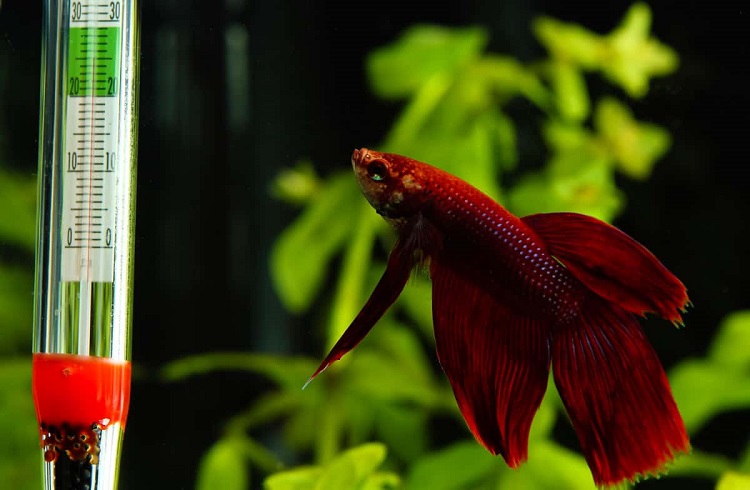
Here's where things get a chip tricky. Each fish has its ain preferred temperature range and tolerance to temperature swings.
Generally speaking, when it comes to temperature preference, fish volition fall into one of three categories:
- Cold-water fish: Beneath 68°F (20°C)[1]
- Tropical fish: 75-80°F (24-27°C)[ii]
- Temperate fish: A wider range of temperatures, often overlapping the above categories.[3]
The temperate fish category is a recent cosmos to encompass fish that don't autumn into the cold-water or tropical categories, like goldfish. Fifty-fifty so, temperate fish still take a preferred temperature range where they volition thrive.
Typically, fish that come from large bodies of water, such as oceans or big lakes, are generally less tolerant of temperature swings. This is considering these big ecosystems have stable temperatures, and so the fish have not adapted to fluctuations in temperature.
It'southward upwardly to yous to research whatsoever fish that yous program on calculation to your aquarium to figure out its preferred temperature range. Usually, the place you are ownership your fish volition provide that information – all you need to do is inquire.
Oh, and it goes without saying that the temperature of your tank will determine the fish that you put inside it.
Only be conscientious!
Only considering ii fish tin can live at the same temperature, doesn't mean they should exist added to the aforementioned tank.
I encounter this mistake made by beginners all the time. Take the following two fish for case:
- Fish 1: 64-72°F (18-22°C)
- Fish 2: 72-82°F (22-28°C)
Both fish can survive at 72°F (22°C). As long as you keep the temperature at precisely that, the fish can alive together, correct?
Unfortunately, this isn't the instance. In this instance, both fish would be living at the edge of the temperature range that they find most comfortable, which can lead to both fish condign stressed and having shorter lives.
In the wild, fish don't experience the edges of their temperature range for long. Keeping your tank on the edges of this temperature is like creating a permanent summer or permanent winter for your fish.
Information technology goes without saying that some fish are more than tolerant to temperature changes than others. And those of you with experience will have a better agreement of exactly what temperatures your fish tin can tolerate.
Only for any beginner starting out, stick to the center of the temperature range – it leaves less room for error.
Remember: Just considering your fish is surviving, doesn't mean it is thriving… Fish accept recommended temperature ranges for a reason. Just considering your fish is alive at a temperature outside of this range doesn't hateful it is happy or salubrious.
Suitable temperature for different fishes
Temperature is but one gene we need to consider when caring for our aquatic pets; others include h2o quality and a healthy diet. Likewise high or besides low, and your tropical fish could fall sick.
Goldfish adopt constant temperatures between 68° and 76° F, while cold-water species thrive at around 65 ° F or below. Temperate fish alive in overlapping habitats with tropical and cold-water species, and thus, they can be treated the same temperature-wise.
Freshwater aquariums are designed to exist used in areas not exposed to direct sunlight and with temperatures between 72ºF – 82ºF, depending on the blazon of freshwater fish you intend to employ.
Some fish prefer libation h2o (67°-70°F) while some savour warmer waters (80°-86°F). It is advised to find out what volition best match your preference and the fish you accept chosen for your tank.
Finding the right temperature for a saltwater tank isn't very straightforward either. Saltwater fish come from oceans (or bodies of water) worldwide, and their environments vary slightly from one to the next.
Yous should base of operations the water temperature of your tank on what types of fish you put in information technology. Generally, 79 degrees F (26°C) is an excellent medium but, again, check with your local marine life store or internet to come across which range they adopt.
Exist aware of the effects increased temperature can have in your fish- and coral tanks! Most reef tanks are plant naturally at a temperature betwixt 82 to 84 degrees F (29°C), and it's standard advice to continue a reef tank at 78 – 80°F (25°C).
However, as our ambitions are to maintain, breed, and heighten fish, well-nigh species volition observe the environment more than than comfortable at most 77 – 78 (25.2 – 25.4) °F!
Following are h2o parameters for different aquarium types:
| Aquarium blazon | Suitable temprature | Suitable pH levels |
| Tropical fish tank | 75-80°F (24-27°C) | 6.5-7.v |
| Shrimp tank | 75-80°F (24-27°C) | 6.five-7.5 |
| Planted tank & Discus | 75-lxxx°F (24-27°C) | vi.0-7.5 |
| African cichlid tank | 75-80°F (24-27°C) | seven.4-viii.6 |
| Fundamental American cichlid | 75-lxxx°F (24-27°C) | seven.0-viii.0 |
| South American cichlid | 75-lxxx°F (24-27°C) | 6.0-7.five |
| Brackish tank | 75-lxxx°F (24-27°C) | seven.5-8.4 |
| Saltwater fish & alive rock (FOWLR) | 75-80°F (24-27°C) | 8.1-viii.4 |
| Reef tank | 75-80°F (24-27°C) | eight.1-8.four |
| Pond | 33-86°F (0-30°C) | vi.five-seven.5 |
| Axolotl tank | 60-64°F (xvi-18°C) | 6.v-eight.0 |
| Turtle tank | 72-79°F (22-26°C) | vi.0-8.0 |
Breeding Temperature
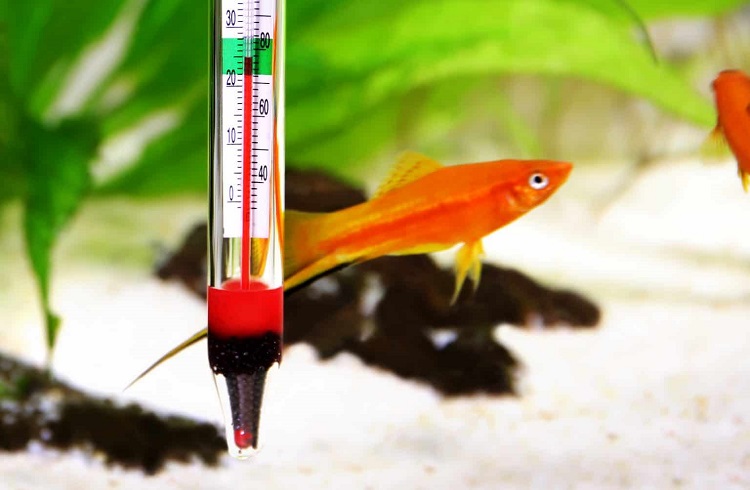
Most fish require a specific temperature to brood. Sometimes that temperature is higher than the standard range, just breeding is triggered past a driblet in water temperatures in many cases.
During fish breeding, it's essential to know the water temperature requirements of the species being spawned. This mode, you can adjust the temperature in another tank specifically for these fish'south needs. In that mode, they don't feel like they are beingness left out or surrounded by as well many other fish.
The right water temperature and pH should be considered while breeding fish. Certain species of fish can breed even in acidic water, but others can't breed in water not equally acidic as they require. You lot can adjust the ideal water temperature and pH according to the species of fish i wishes to breed.
For case, the correct temperature for breeding bettas is 28°C (82.4°F) for the first calendar week and lower afterward. The pH should be at 6.5 to seven.5. Fish breeders unremarkably get this temperature from a chiller or from a room where the temperature is constant.
The virtually vital matter is to keep the temperature stable; otherwise, the eggs volition catch fungus. A buffer is needed to become the temperature right, preventing pH shock and stabilizing the pH. When adding the buffer, information technology should be washed gradually to stabilize the pH, making the pH less acidic and more than healthy for the eggs.
The best breeding temperature for fish changes depending on the fish diversity. There is no unmarried, standard temperature. For example, in general, tropical fish tin can brood at a temperature of 22 C (71.half-dozen F). Just some species practise ameliorate at 25 C (77 F), while others have a lower limit at xviii C (64 F).
In that location is also a wide range of water temperatures that fish species can tolerate. For example, you can keep goldfish in water at a temperature of 18-30 C (64-86 F) and cichlids in water at 25-28 C (77-82 F). The boilerplate home aquarium temperature is 72F, but fish similar Discus and Angels prefer college temperatures.
Fish species do not take a single reproductive bicycle each twelvemonth. Some tropical fish tin breed at any time of the year, so the temperature is not a big event here. On the other hand, if the temperature is too low, they can't brood.
How do y'all maintain the platonic temperature in your aquarium?
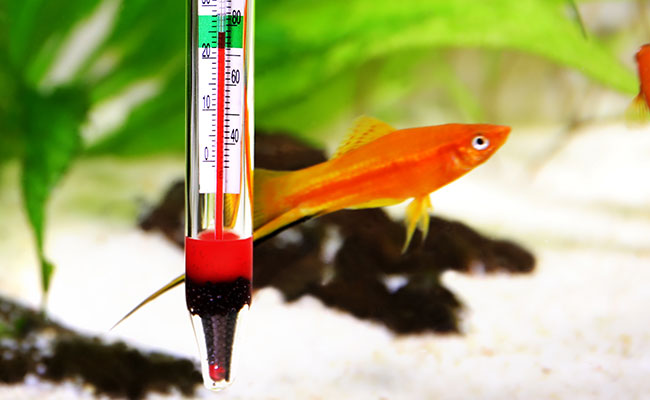
Now that you lot know why the correct temperature is so important, it's time to maintain it.
If you know what the temperature is within your aquarium, then half the battle is won. Unfortunately, warm water looks the same as cold h2o.
That'southward why you need an accurate aquarium thermometer. It really takes the guesswork out of monitoring your aquarium and is an essential purchase for every aquarium!
With your thermometer in hand, information technology'due south time to take a closer look at how you can maintain the perfect temperature for your fish.
Getting the nuts correct…
Information technology all starts with where your fish tank is located.
Drafts from open windows or Ac vents rapidly cause the temperature in your aquarium to plummet.
Similarly, the midday sun that is shining through your windows, hitting your aquarium, can cause the h2o temperature to soar.
This is why it's then important to cull the correct location for your fish tank when setting it up!
Heating your aquarium
Aquarium too cold? Information technology'due south time to turn upwards the estrus!
Heating your tank is darn elementary. All you need is a practiced aquarium heater. This handy piddling device sits underwater and will continue to warm your water until your desired temperature is reached.
Cooling your aquarium
If you live in a warmer area (looking at you, Arizona!) then you might have the opposite problem. The hot conditions makes your aquarium water besides warm.
Leaving your Ac cranked is overkill, not to mention expensive! The cheapest solution is to use a fan. While whatever old fan will do, there are fan systems specifically designed to go on your aquarium at the correct temperature.
Those of you lot with larger tanks might notice that a fan isn't enough to lower the temperature. In this case, you have the selection of using an aquarium chiller – essentially a canister filter that cools the water equally information technology flows through.
Maintaining the temperature automatically
Wouldn't it be great if yous could gear up your heating and cooling equipment to remain switched off and only plow on when needed?
An aquarium heater controller is the exact production you lot are looking for!
Simply plug in your heater and fan, set the desired temperature and walk away. If the water temperature drops below this setting, the heater will automatically turn on to warm your h2o back up.
Similarly, if the water temperature gets too hot, the controller will turn your heater off and turn your fan on, to cool the water back downward.
All without any endeavour on your part. Pretty cool, huh?
All-time Temperature for Your Aquarium
One cardinal to fish-keeping is temperature. Tropical fish – the kind you can buy at the store – are virtually comfortable betwixt 75 to 80 degrees Fahrenheit (24 to 27 degrees Celsius).
Cool water fish, similar goldfish and koi, need water that'south much cooler than that – between sixty and 75 degrees F (15 and 24 C) or even colder. Recall: Goldfish don't practise well in temperatures above 80 degrees F. And then if you take a fancy tropical fish tank, do not put a cold-water fish like a goldfish into it!
The temperature for your fish depends on the species of fish included in your aquarium. Figure out what kind of fish you are interested in keeping earlier setting up a tank and compare their temperature requirements with those of the water and heater you plan to utilize.
Only become with a reliable thermometer to regularly check the water temperature to ensure that whatever rapid or significant changes avoid sudden alterations in the climate inside the tank.
Determination
A stable water temperature, inside a few degrees of the recommended range, is important for keeping everything in your aquarium happy and healthy.
With the help of heaters and chillers, keeping your aquarium at the proper temperature has never been easier!
Practice y'all accept any temperature tips? Let me know in the comments below!
Source: https://fishlab.com/aquarium-temperature/
0 Response to "Again Fish That Can Handle 80 Temperatures"
Postar um comentário